
WHY READING HABITS MAY BECOME THE BIGGEST EDUCATIONAL ADVANTAGE IN THE AI ERA
For years, education systems rewarded students for finding the right answers quickly.
But the future may reward something very different:
the ability to think beyond the answer.
Artificial intelligence can now summarize articles, solve equations, generate essays, translate languages, and retrieve information within seconds.
Information is no longer scarce.
Attention, interpretation, and critical thinking are.
This is why reading habits may become one of the most important educational advantages of the next decade.
Not simply reading for exams.
But reading that builds:
- concentration,
- comprehension,
- curiosity,
- emotional intelligence,
- and independent thought.
The Real Crisis Is Not Information Scarcity
Today’s students are surrounded by endless content:
- short videos,
- instant summaries,
- notifications,
- AI-generated explanations,
- and algorithm-driven feeds.
Yet many struggle with:
- sustained focus,
- deep comprehension,
- analytical reasoning,
- and reflective thinking.
The issue is not lack of information.
It is fragmented attention.
Reading long-form material trains the brain differently from rapid content consumption. It develops patience, interpretation, imagination, and mental endurance — skills becoming increasingly rare in digital environments.
AI Will Reward Thinkers, Not Just Test Takers
As automation grows, routine knowledge tasks will become easier.
But uniquely human strengths will become more valuable:
- judgment,
- context awareness,
- ethical reasoning,
- creativity,
- empathy,
- and complex problem-solving.
Strong reading habits strengthen all of these abilities.
A student who reads consistently learns to:
- connect ideas across subjects,
- understand nuance,
- process conflicting perspectives,
- and communicate more effectively.
These are future-proof capabilities.
Reading Builds Cognitive Resilience
One of the least discussed educational challenges today is declining attention stability.
Many students consume information rapidly but struggle to stay mentally engaged with difficult material for extended periods.
Reading trains cognitive endurance.
It teaches students how to:
- remain focused,
- tolerate complexity,
- slow down thinking,
- and engage deeply instead of react instantly.
This becomes increasingly important in a world dominated by distraction economies.
Educational Inequality Also Includes Reading Access
The ability to build reading habits is deeply connected to environment.
Many children still lack:
- access to books,
- quiet study spaces,
- reading mentors,
- digital reading tools,
- or family reading culture.
In some communities, students encounter books only inside classrooms.
That limitation affects long-term learning confidence.
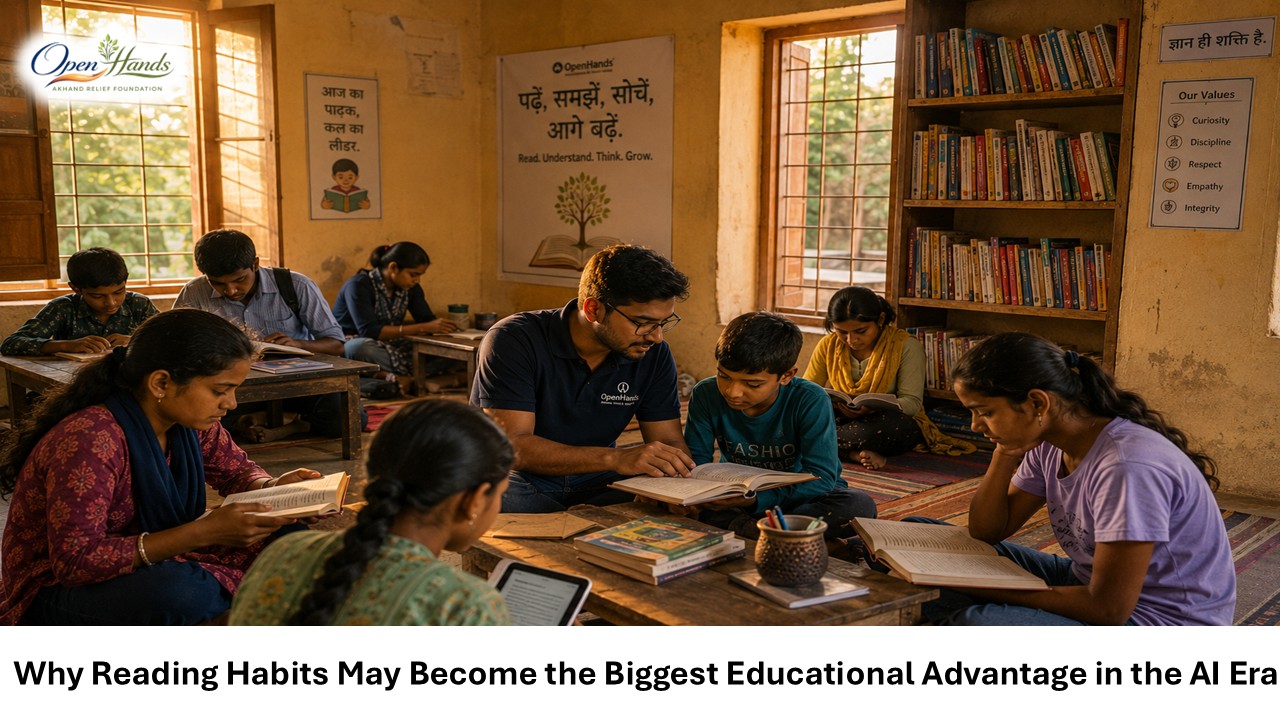
Community reading spaces, mobile libraries, peer learning groups, and mentorship programs can dramatically improve educational engagement — especially for first-generation learners.
Language Confidence Shapes Opportunity
Reading also influences communication confidence.
Students who read regularly often develop:
- stronger vocabulary,
- better expression,
- improved comprehension,
- and greater confidence in academic or professional environments.
This matters significantly for children navigating multilingual realities where local languages, Hindi, and English may intersect daily.
Language confidence often determines:
- participation,
- interview performance,
- leadership visibility,
- and career access.
Reading quietly strengthens all of these areas over time.
Digital Reading Must Become More Inclusive
The future of reading is increasingly hybrid.
Students now learn through:
- e-books,
- educational apps,
- audiobooks,
- digital articles,
- and AI-assisted learning systems.
But digital inclusion remains uneven.
Many learners still face:
- inconsistent internet access,
- shared devices,
- screen fatigue,
- or limited digital literacy.
The goal should not be replacing books with technology.
It should be expanding access to learning in multiple formats while preserving deep comprehension and critical engagement.
Why Reading Also Improves Emotional Intelligence
Stories shape perspective.
Students exposed to diverse experiences through reading often develop stronger:
- empathy,
- emotional understanding,
- cultural awareness,
- and social sensitivity.
This is especially important in increasingly polarized and fast-moving digital environments.
Reading helps young people understand lives beyond their immediate surroundings.
That emotional expansion matters for building compassionate communities and responsible future leadership.
Schools Alone Cannot Build Reading Culture
Reading culture grows through ecosystems.
Communities play a major role through:
- local libraries,
- family encouragement,
- mentorship,
- storytelling sessions,
- peer reading circles,
- and accessible educational spaces.
When reading becomes normalized socially, learning extends beyond exams.
Students begin exploring knowledge voluntarily instead of academically alone.
That shift changes educational outcomes significantly.
The Future Belongs to Learners Who Can Think Independently
The AI era will not reduce the importance of education.
It will redefine what educational strength actually means.
Memorization alone will matter less.
Interpretation will matter more.
Speed alone will matter less.
Depth will matter more.
Students who can:
- analyze information critically,
- understand context,
- ask better questions,
- and communicate thoughtfully
will remain valuable regardless of technological change.
Reading is still one of the most effective ways to build those abilities consistently.
Not because books compete with technology.
But because deep thinking becomes more important as technology accelerates.
OpenHands Akhand Relief Foundation continues to support educational resilience through community learning awareness, accessible educational support systems, mentorship-driven learning environments, and initiatives that encourage long-term intellectual growth beyond examination performance alone.