
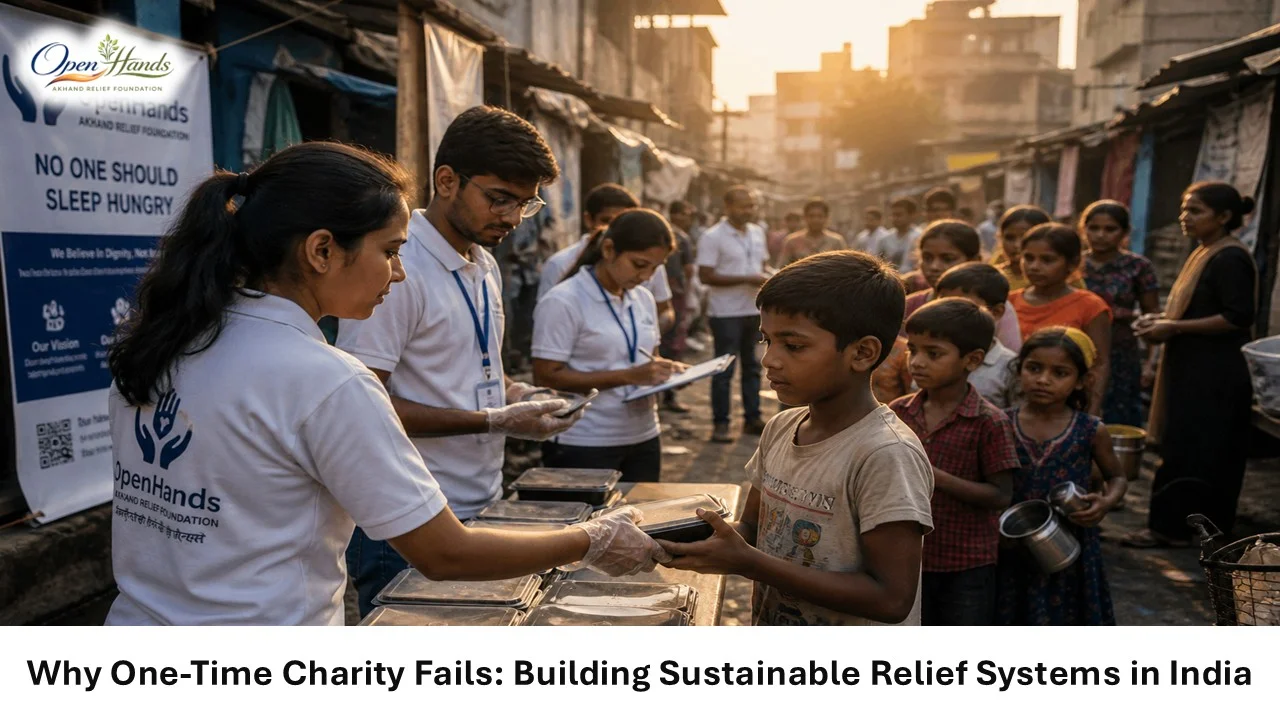
WHY ONE-TIME CHARITY FAILS: BUILDING SUSTAINABLE RELIEF SYSTEMS IN INDIA
A single meal can stop hunger for a day. But what happens tomorrow?
This is the fundamental gap in most charity efforts today. While one-time donations and occasional drives feel impactful, they often fail to create lasting change. Real transformation doesn’t come from isolated acts of kindness—it comes from consistent, well-structured systems that address problems at their root.
The Problem with One-Time Charity
One-time charity operates on immediacy. It reacts to visible problems—hunger, lack of clothing, emergency needs—but rarely builds continuity.
Here’s where it falls short:
- No continuity: Aid is temporary, and the same need resurfaces quickly
- No tracking: There’s little visibility into long-term outcomes
- Dependency cycles: Beneficiaries remain reliant instead of becoming stable
- Resource inefficiency: Repeated short-term efforts consume more resources over time
In India, where poverty is often systemic rather than situational, these gaps become even more pronounced. A one-day food drive cannot solve a recurring access issue. A blanket donation in winter doesn’t address long-term living conditions.
Relief Without Systems Is Unsustainable
Relief is necessary—but without structure, it becomes repetitive rather than transformative.
Sustainable relief systems focus on:
- Consistency over intensity
- Planning over reaction
- Tracking over assumption
- Stability over short-term relief
Instead of asking, “How many people did we help today?”, the better question becomes:
“How many people no longer need help tomorrow?”
That shift changes everything.
What Sustainable Charity Looks Like
A system-driven approach doesn’t eliminate compassion—it strengthens it.
Here’s how sustainable models work differently:
1. Regular Food Distribution Systems
Not occasional drives, but scheduled, predictable access to meals. This reduces uncertainty and builds stability for families.
2. Community Mapping and Data Tracking
Understanding who needs help, how often, and why. This prevents duplication and ensures targeted support.
3. Local Involvement and Ownership
Communities aren’t just recipients—they become participants. This increases accountability and long-term success.
4. Resource Optimization
Every donation is planned, tracked, and used where it creates the highest impact.
5. Scalability
Systems can expand. Random acts cannot.
Why Systems Create Real Impact
When charity becomes structured, outcomes begin to compound.
- Hunger reduces not just today, but over months
- Families gain predictability and dignity
- Volunteers become part of a process, not just an event
- Donors see measurable, transparent impact
This is how small contributions start creating large-scale change.
The Shift India Needs Right Now
India doesn’t lack generosity. What it often lacks is structured execution.
The future of social impact lies in:
- Data-driven decision making
- Technology-enabled transparency
- Community-led implementation
- Long-term commitment over short bursts of effort
This is where modern non-profits must evolve. Not by doing more, but by doing better—through systems that last.
Moving Beyond Good Intentions
Intentions start change. Systems sustain it.
If charity remains occasional, problems remain permanent. But when relief becomes consistent, structured, and scalable, it begins to break cycles—not just manage them.
At OpenHands Akhand Relief Foundation, the focus is clear: build systems that outlast donations, create stability beyond moments, and ensure that help today reduces the need for help tomorrow.
Because real impact isn’t measured by how much you give once—
it’s measured by how long that impact lasts.