
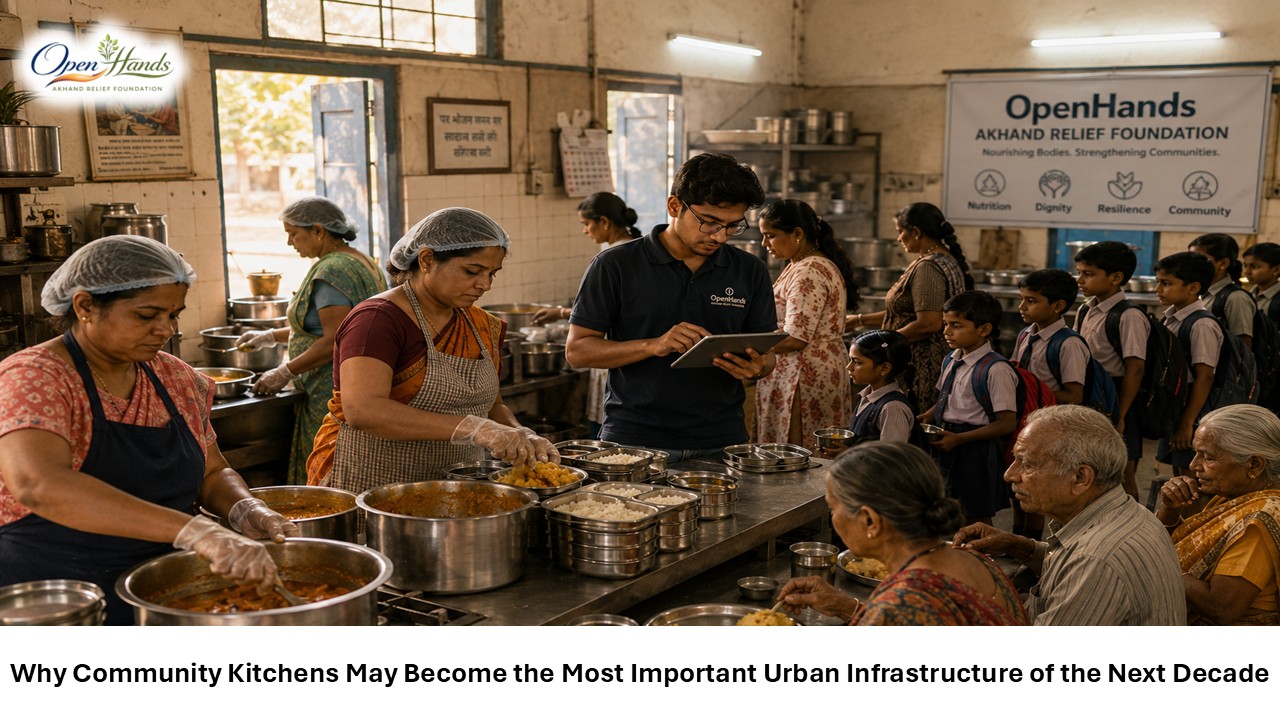
WHY COMMUNITY KITCHENS MAY BECOME THE MOST IMPORTANT URBAN INFRASTRUCTURE OF THE NEXT DECADE
The future of urban resilience may not begin with highways, skyscrapers, or smart technology.
It may begin with a kitchen.
Not a commercial kitchen built for profit.
Not a temporary food camp during emergencies.
But a permanent, community-driven food system designed to ensure that no family is pushed into hunger when economic pressure rises.
Across the world, cities are facing the same pressure points:
- Rising food costs
- Migration into urban areas
- Informal labor instability
- Climate disruptions
- Supply chain breakdowns
- Social isolation in dense populations
Traditional relief systems are struggling to keep pace.
In this environment, community kitchens are quietly emerging as one of the most underestimated forms of social infrastructure.
The Shift From Charity to Shared Urban Stability
For years, food distribution has largely been treated as crisis management.
A flood happens.
A lockdown begins.
Jobs disappear.
Food packets are distributed.
Then the system disappears until the next emergency.
But cities are beginning to realize something important:
Food insecurity is no longer temporary for millions of families.
It is structural.
Daily wage workers, migrant laborers, elderly individuals living alone, low-income students, single mothers, and vulnerable households often experience recurring nutritional instability even when there is no visible disaster.
Community kitchens solve a deeper problem than hunger alone:
they create continuity.
That continuity changes everything.
Why Community Kitchens Work Better Than Fragmented Food Aid
One-time food drives create short-term relief.
Shared food systems create operational resilience.
Well-designed community kitchens can:
- Reduce food waste
- Improve nutritional consistency
- Lower meal costs at scale
- Create local employment
- Strengthen neighborhood trust
- Support disaster response faster
- Help vulnerable families maintain dignity
The most effective models are hyperlocal.
They operate inside communities rather than above them.
Local women often lead operations. Nearby vendors supply ingredients. Volunteers support logistics. Residents participate instead of remaining passive recipients.
This transforms food support from dependency into participation.
Food Infrastructure Is Also Public Health Infrastructure
Malnutrition in urban environments is often hidden.
A child may appear “fed” while lacking nutritional quality.
A laborer may skip meals silently to manage rent.
An elderly person may reduce food intake to afford medicines.
Over time, these patterns create:
- Weakened immunity
- Poor educational performance
- Lower workplace productivity
- Chronic health conditions
- Increased healthcare pressure
Community kitchens can stabilize nutrition before these problems escalate.
Simple interventions matter:
- Consistent protein access
- Fresh cooked meals
- Child nutrition programs
- Affordable breakfast systems
- Heat-safe hydration stations during summers
The long-term economic impact of preventative nutrition is massive.
The Role of Technology in Community Food Systems
The next generation of humanitarian food systems will likely combine local trust with lightweight technology.
Not complicated platforms.
Practical coordination.
Examples include:
- Real-time meal demand tracking
- Volunteer scheduling systems
- Waste reduction analytics
- Local supply coordination
- Digital transparency dashboards
- Nutrition monitoring
- Emergency surge-response mapping
AI and automation may eventually help predict shortages before communities experience them.
But technology alone is not enough.
The strongest systems still depend on human relationships:
- Local cooks
- Community organizers
- Volunteers
- Residents
- Small suppliers
Technology should support human coordination, not replace it.
Community Kitchens Also Fight Isolation
Urban poverty is not only financial.
It is social.
Large cities often create invisible loneliness:
- Elderly individuals living without support
- Migrant workers disconnected from family
- Students skipping meals privately
- Women carrying silent household burdens
Shared meal spaces rebuild social interaction.
People begin recognizing each other again.
Conversations return.
Trust forms naturally around routine.
This is one reason community kitchens often become more than food spaces. They evolve into:
- Support networks
- Information hubs
- Learning spaces
- Volunteer ecosystems
- Emergency response centers
Food creates connection faster than most interventions.
The Climate Crisis Will Increase the Need for Shared Food Systems
Extreme heat, floods, crop instability, and rising transportation costs are already affecting food affordability.
Cities that lack localized food resilience will face deeper instability in the coming years.
Community kitchens can help cities respond faster during disruptions because they already possess:
- Existing distribution networks
- Local volunteer systems
- Cooking infrastructure
- Community trust
- Operational coordination
Prepared systems save more lives than reactive systems.
That principle applies to food security as much as disaster response.
What Strong Community Kitchens Actually Require
Successful community kitchens are rarely built on donations alone.
They survive through systems.
That includes:
- Transparent operations
- Local partnerships
- Consistent volunteers
- Supply planning
- Hygiene protocols
- Financial accountability
- Community participation
- Long-term operational thinking
Without structure, even compassionate initiatives become unstable.
With structure, small kitchens can feed thousands consistently.
The Future of Cities May Depend on Shared Care Systems
Modern cities are efficient at commerce.
But many are fragile at care.
That gap is becoming impossible to ignore.
As economic pressure rises globally, cities will increasingly need systems that protect human stability at the neighborhood level.
Community kitchens represent something larger than food distribution.
They represent a model where:
- care is organized,
- dignity is preserved,
- resources are shared,
- and resilience becomes collective.
The strongest societies of the future may not be the ones with the most advanced infrastructure alone, but the ones that ensure no person is left unsupported during instability.
OpenHands Akhand Relief Foundation continues to explore sustainable, community-centered systems that strengthen resilience through coordination, nutrition support, local participation, and long-term humanitarian infrastructure built around people rather than temporary visibility.