
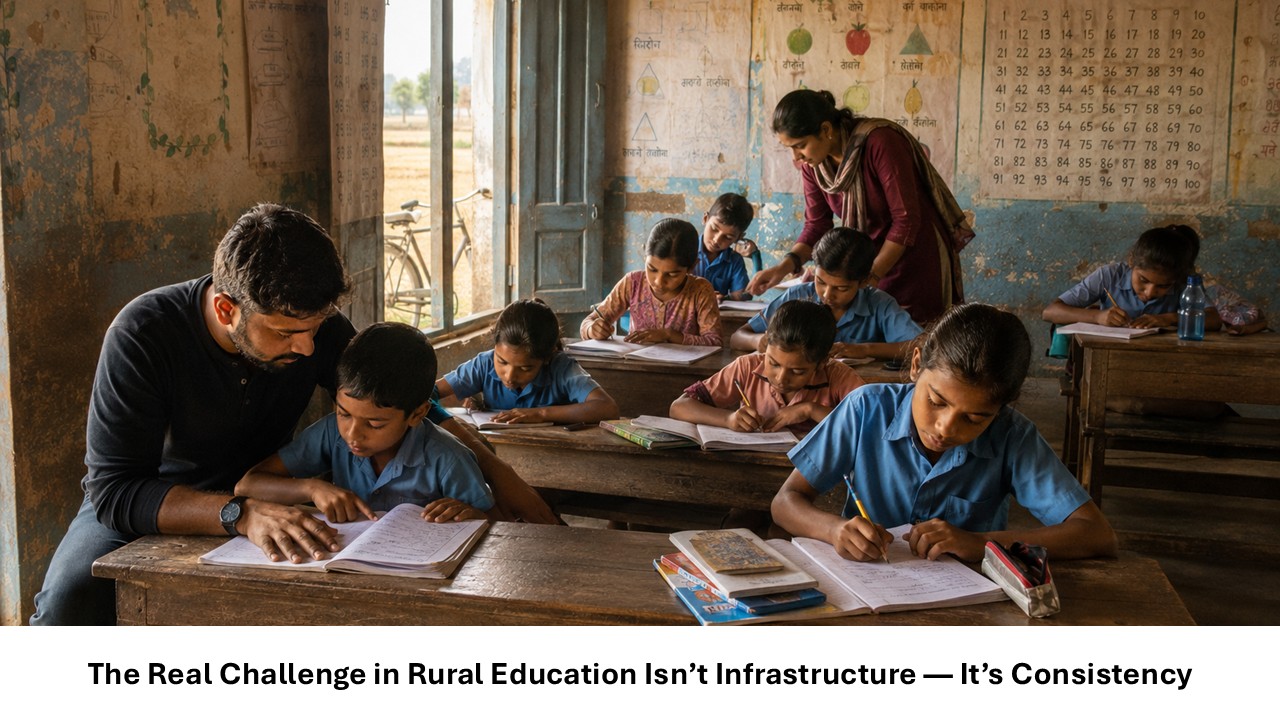
THE REAL CHALLENGE IN RURAL EDUCATION ISN’T INFRASTRUCTURE — IT’S CONSISTENCY
A school building alone does not guarantee education. A classroom without continuity quickly becomes another statistic in the cycle of educational inequality.
Across rural India, the conversation often focuses on infrastructure gaps — more classrooms, better roads, digital devices, or new facilities. These investments matter. But the harder challenge lies elsewhere: sustaining consistent learning environments that children can rely on every single day.
Many rural students are not failing because they lack intelligence or ambition. They are falling behind because the systems around them remain unpredictable.
Enrollment Has Improved. Learning Stability Has Not.
Over the last decade, school enrollment rates in rural India have significantly improved. Midday meal schemes, awareness campaigns, and government programs have brought more children into classrooms than ever before.
But attendance and learning continuity remain fragile.
A child may attend school for two weeks and then disappear for seasonal labor migration. A teacher may be assigned to multiple schools. Internet access may exist but remain unreliable. Families struggling financially may prioritize immediate income over long-term education.
The result is inconsistent learning cycles that quietly compound over time.
This is where education inequality deepens — not only through lack of access, but through lack of sustained engagement.
Rural Education Challenges Are Systemic, Not Individual
It is easy to frame rural education as a problem of “resources.” In reality, the issue is more operational and systemic.
Common disruptions include:
- Teacher shortages and irregular staffing
- Seasonal migration of families
- Limited parental literacy support
- Poor transportation access during monsoon seasons
- Inconsistent digital connectivity
- Economic pressure forcing children into work
- Lack of mentorship outside school hours
Each disruption may seem temporary. Together, they create long gaps in learning consistency.
A student who repeatedly misses foundational lessons in mathematics or language rarely catches up without targeted intervention. Over time, confidence declines, dropout risk increases, and educational mobility weakens.
Infrastructure Without Continuity Creates Fragile Outcomes
Many well-intentioned programs focus heavily on visible infrastructure because it is measurable and immediate.
A new classroom can be photographed. A computer lab can be inaugurated. A school wall can be painted.
But long-term educational progress depends on systems that are less visible:
- Consistent teacher presence
- Daily reinforcement of learning
- Local mentorship networks
- Parent engagement
- Community accountability
- Reliable nutrition support
- After-school learning continuity
Without these systems, infrastructure alone struggles to produce meaningful educational outcomes.
NGO Education Programs Work Best When They Build Stability
Some of the most effective NGO education programs in India succeed not because they provide massive resources, but because they create continuity where instability exists.
This often includes:
Community-Based Learning Support
Local volunteers and educators help bridge gaps when formal schooling becomes inconsistent.
Regular Follow-Ups
Tracking attendance and maintaining family engagement prevents silent dropouts.
Supplementary Learning Sessions
Even small evening or weekend sessions can help children maintain academic momentum.
Nutrition and Welfare Integration
Children learn better when food insecurity and basic health concerns are addressed alongside education.
Local Trust Networks
Communities participate more actively when programs are built with local involvement instead of external dependency.
Sustainable rural education requires ecosystems, not isolated interventions.
Technology Helps — But Only When Human Systems Exist
Digital education is often presented as the solution for rural learning gaps. Technology can absolutely improve reach and access, but devices alone cannot solve inconsistency.
A tablet cannot replace mentorship. Recorded lessons cannot fully substitute human accountability. Internet access without guidance often creates low engagement.
The strongest education models combine technology with community support systems:
- Local facilitators
- Structured schedules
- Offline learning backups
- Parent communication
- Hybrid learning models
- Consistent monitoring
Technology becomes effective when it strengthens human systems rather than attempting to replace them.
Consistency Builds Confidence
One overlooked aspect of rural education is emotional continuity.
Children thrive when they experience predictable support. A teacher who shows up regularly. A volunteer who follows up. A learning center that remains open consistently. Small acts of reliability build confidence and belonging.
For first-generation learners especially, education is not just academic — it is psychological. Stability helps students believe that learning is meant for them.
That belief changes long-term outcomes.
The Future of Rural Education Depends on Long-Term Commitment
India does not only need more educational access. It needs more educational consistency.
Real progress in rural education will come from strengthening systems that keep children connected to learning over years — not weeks.
This means investing in:
- Community-driven education models
- Teacher support systems
- Local mentorship networks
- Attendance continuity strategies
- Hybrid learning ecosystems
- Family engagement programs
Short-term educational interventions may create visibility. Long-term consistency creates transformation.
At OpenHands Akhand Relief Foundation, we believe sustainable social impact begins with dependable systems that communities can trust over time. In education, consistency is not a secondary factor — it is the foundation that determines whether opportunity truly reaches every child.