
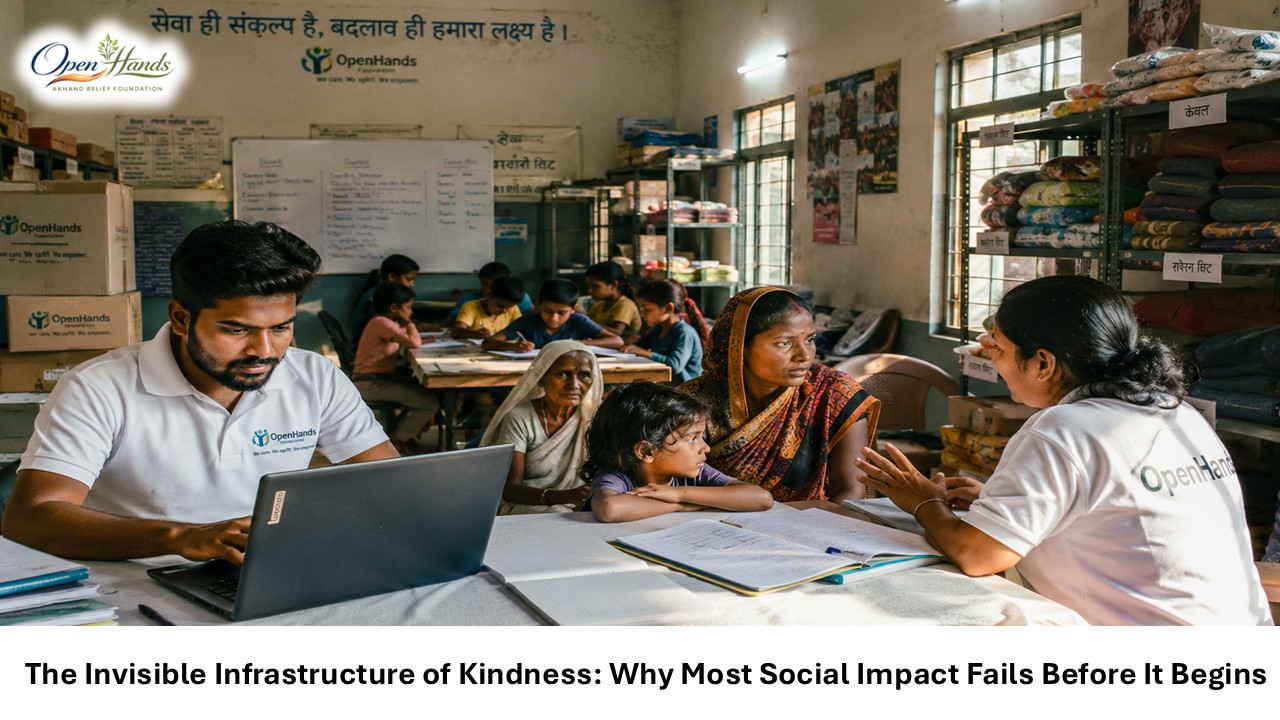
THE INVISIBLE INFRASTRUCTURE OF KINDNESS: WHY MOST SOCIAL IMPACT FAILS BEFORE IT BEGINS
The future of urban resilience may not begin with highways, skyscrapers, or smart technology.
It may begin with a kitchen.
Not a commercial kitchen built for profit.
Not a temporary food camp during emergencies.
But a permanent, community-driven food system designed to ensure that no family is pushed into hunger when economic pressure rises.
Across the world, cities are facing the same pressure points:
- Rising food costs
- Migration into urban areas
- Informal labor instability
- Climate disruptions
- Supply chain breakdowns
- Social isolation in dense populations
Traditional relief systems are struggling to keep pace.
In this environment, community kitchens are quietly emerging as one of the most underestimated forms of social infrastructure.
The Problem With Emotional-Only Charity
Modern charity is often designed around moments. Floods. Viral stories. Festivals. Winter drives. Emergency appeals.
Emotion mobilizes people quickly. But emotion alone rarely sustains systems.
A blanket distributed once helps someone survive a night.
A reliable distribution network helps entire communities survive winters for years.
The difference matters.
Many grassroots initiatives begin with strong intent but collapse under operational gaps:
- No local ownership
- No continuity plan
- No volunteer retention system
- No transparent process
- No documentation
- No accountability loops
- No measurable outcomes
Without systems, even good intentions become inconsistent.
Communities notice inconsistency faster than organizations do.
Sustainable Impact Is Operational, Not Performative
Social impact is often misunderstood as visibility. In reality, the strongest humanitarian systems are usually quiet.
They are repetitive. Structured. Predictable.
The organizations creating lasting change are not necessarily the loudest online. They are the ones building operational discipline behind the scenes.
That includes:
Consistent Community Mapping
Needs change rapidly. A neighborhood needing food support today may need educational access six months later.
Organizations that maintain local relationships adapt faster because they understand shifting realities in real time.
Volunteer Systems Instead of Volunteer Events
Most nonprofits recruit volunteers. Very few build volunteer ecosystems.
There is a major difference between:
- “Help us this weekend”
and - “Become part of a long-term support structure”
Retention creates stability. Stability creates trust.
Data That Improves Human Decisions
Technology matters when it reduces waste, duplication, and delay.
Simple systems can dramatically improve outcomes:
- Resource tracking
- Beneficiary verification
- Distribution scheduling
- Follow-up coordination
- Local reporting structures
The future of social good will belong to organizations that combine empathy with operational intelligence.
Why Communities Trust Consistency More Than Promises
People living through hardship develop strong filters.
They have seen campaigns arrive and disappear.
They have heard speeches before.
They recognize temporary attention.
Trust is not built through announcements. It is built through repeated presence.
A small organization consistently delivering support for three years often creates deeper impact than a larger campaign operating for three weeks.
Consistency changes psychology.
When communities begin expecting reliability, participation increases:
- Parents send children to learning programs
- Women engage in skill-building initiatives
- Local leaders cooperate more openly
- Volunteers commit longer
- Donors gain confidence in transparency
Impact compounds when predictability exists.
The Hidden Cost of Fragmented Aid
One of the least discussed problems in social work is fragmentation.
Different groups often work toward similar goals without coordination:
- Duplicate distributions
- Uneven coverage
- Wasted logistics
- Short-term visibility campaigns
- Resource leakage
Meanwhile, some communities remain completely underserved.
The future of humanitarian work requires interconnected systems:
- Shared local intelligence
- Better coordination
- Technology-assisted planning
- Hyperlocal partnerships
- Community-led implementation
Aid becomes more powerful when organizations stop operating like isolated islands.
The Role of Technology in Human-Centered Relief
Technology alone does not solve poverty.
But poor systems make poverty harder to fight.
Digital tools are beginning to reshape grassroots work in practical ways:
- Volunteer coordination platforms
- AI-assisted resource planning
- Rural education accessibility
- Donation transparency tracking
- Predictive supply management
- Local issue reporting systems
The key is balance.
Communities do not need “innovation theater.”
They need tools that reduce friction and improve reliability.
The most effective systems are often the simplest:
- Faster response times
- Better communication
- Accurate records
- Lower operational waste
Human trust still remains the foundation.
Real Change Looks Boring Before It Looks Historic
This is the uncomfortable truth about sustainable impact:
Most transformational work looks ordinary while it is happening.
Weekly distributions.
Monthly reporting.
Volunteer onboarding.
Training sessions.
Phone calls.
Data cleanup.
Community meetings.
No viral moment.
No dramatic headline.
But over years, these quiet systems reshape lives at scale.
Children remain in school longer.
Families avoid crisis cycles.
Communities become more resilient.
Local leadership strengthens.
Dependency decreases.
That is what real infrastructure does.
The Next Era of Social Impact
The future belongs to organizations that understand one critical shift:
People no longer trust visibility alone.
They trust proof of continuity.
Donors want transparency.
Volunteers want structure.
Communities want reliability.
Partners want measurable outcomes.
The organizations that survive the next decade will not be those chasing attention constantly. They will be the ones quietly building systems capable of sustaining compassion over time.
Because kindness without infrastructure fades quickly.
But compassion supported by systems can outlast generations.
OpenHands Akhand Relief Foundation continues to focus on scalable, community-driven support systems that prioritize consistency, transparency, and long-term resilience over temporary visibility. Sustainable impact begins when helping people becomes a structure, not an event.