
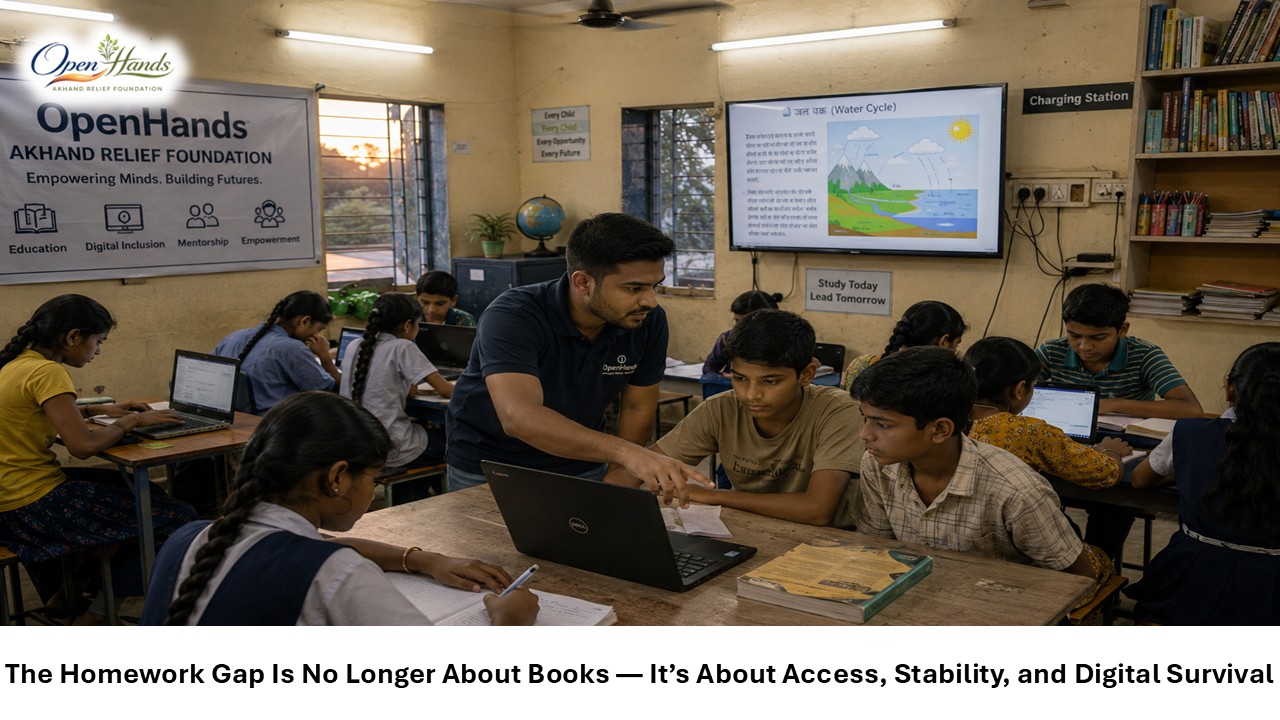
THE HOMEWORK GAP IS NO LONGER ABOUT BOOKS — IT’S ABOUT ACCESS, STABILITY, AND DIGITAL SURVIVAL
A child can attend school every day and still fall behind silently.
Not because they lack intelligence.
Not because they lack ambition.
But because learning today depends on systems many families still do not have access to.
A stable internet connection.
A charged device.
A quiet place to study.
Reliable electricity.
Digital literacy at home.
Time away from household labor.
Access to guidance when confusion appears.
This is the new homework gap.
And it is widening faster than most education systems are prepared for.
Education Has Quietly Become Infrastructure-Dependent
For decades, educational inequality was measured through visible markers:
- School enrollment
- Classroom availability
- Teacher shortages
- Textbook access
Those challenges still matter. But modern education now depends heavily on invisible infrastructure.
Assignments move online.
Learning materials become digital.
Exams require technological familiarity.
Communication happens through apps.
Scholarships depend on digital forms.
Opportunities increasingly require internet access.
Children without digital access are no longer just disconnected from information.
They are disconnected from participation itself.
The Problem Is Bigger Than Devices
Many discussions around digital education stop at distributing tablets or laptops.
But access alone does not create learning continuity.
A student may own a smartphone and still struggle because:
- Internet data is inconsistent
- Multiple siblings share one device
- Electricity outages interrupt study time
- Parents cannot assist digitally
- Homes lack quiet environments
- Students work after school hours
Technology without support systems often creates uneven outcomes.
The real challenge is educational stability.
Why the Homework Gap Becomes a Long-Term Economic Problem
Educational inequality compounds over time.
A child missing digital familiarity today may later struggle with:
- Online applications
- Skill certifications
- Remote work opportunities
- Competitive exams
- AI-assisted learning environments
- Employment systems increasingly dependent on technology
This creates a dangerous cycle:
limited access today reduces economic mobility tomorrow.
The consequences are not individual alone. They affect entire communities.
When educational gaps widen:
- Workforce readiness declines
- Local economies weaken
- Social mobility slows
- Generational poverty deepens
Education systems are no longer separate from economic resilience.
They are directly connected.
The Hidden Importance of Safe Study Environments
One of the most overlooked educational inequalities is space.
Many students do not have a consistent place to focus.
Some study near busy roads.
Others share single-room homes with entire families.
Some balance caregiving responsibilities while preparing for exams.
A stable learning environment dramatically affects:
- Concentration
- Retention
- Confidence
- Attendance
- Emotional well-being
This is why community-based learning centers matter.
Even modest spaces with:
- electricity,
- internet,
- mentorship,
- desks,
- and structured quiet hours
can significantly improve educational continuity.
Digital Literacy Is Now a Survival Skill
The next generation will not compete only through degrees.
They will compete through adaptability.
Students increasingly need:
- Digital communication skills
- Online research ability
- Information filtering
- AI literacy
- Technical confidence
- Problem-solving capacity
Without these skills, students risk exclusion from future opportunities even if they complete formal schooling.
The education gap is evolving from literacy inequality into capability inequality.
Why Human Mentorship Still Matters More Than Technology
Technology can improve learning access.
But human encouragement still determines persistence.
Students from vulnerable backgrounds often need:
- Academic guidance
- Emotional reinforcement
- Career exposure
- Confidence-building
- Accountability systems
One mentor consistently checking in can change educational outcomes dramatically.
This is especially important for:
- First-generation learners
- Rural students
- Girls facing social barriers
- Students recovering from educational interruptions
The future of education must combine digital access with human support systems.
Community Learning Models May Define the Future
Schools alone cannot solve modern educational inequality.
Communities increasingly need localized learning ecosystems:
- Shared digital learning spaces
- Volunteer-led tutoring
- Weekend mentorship sessions
- Skill development workshops
- Career awareness programs
- Device-sharing systems
- Hybrid education support centers
The strongest education systems of the future may be those integrated deeply into communities rather than isolated inside institutions alone.
The Goal Is Not Just Enrollment — It Is Continuity
Many children enter school.
Far fewer receive uninterrupted learning pathways.
The difference between enrollment and continuity determines long-term outcomes.
Educational resilience means ensuring students can continue learning despite:
- economic pressure,
- digital barriers,
- migration,
- family instability,
- or social disadvantage.
That requires systems, not temporary campaigns.
The Future of Social Impact Will Depend on Educational Stability
The world is entering an era where education affects every major development challenge:
- employment,
- health,
- gender equality,
- digital inclusion,
- climate adaptation,
- and economic mobility.
Communities that fail to create stable educational ecosystems will face widening inequality for generations.
But communities investing in accessible, adaptive, and human-centered learning systems can transform entire futures.
Education is no longer only about schooling.
It is about whether children can participate meaningfully in the world being built around them.
OpenHands Akhand Relief Foundation continues to support community-centered educational resilience through accessible learning support, digital inclusion awareness, grassroots mentorship, and systems designed to help students continue learning consistently despite social or economic barriers.