
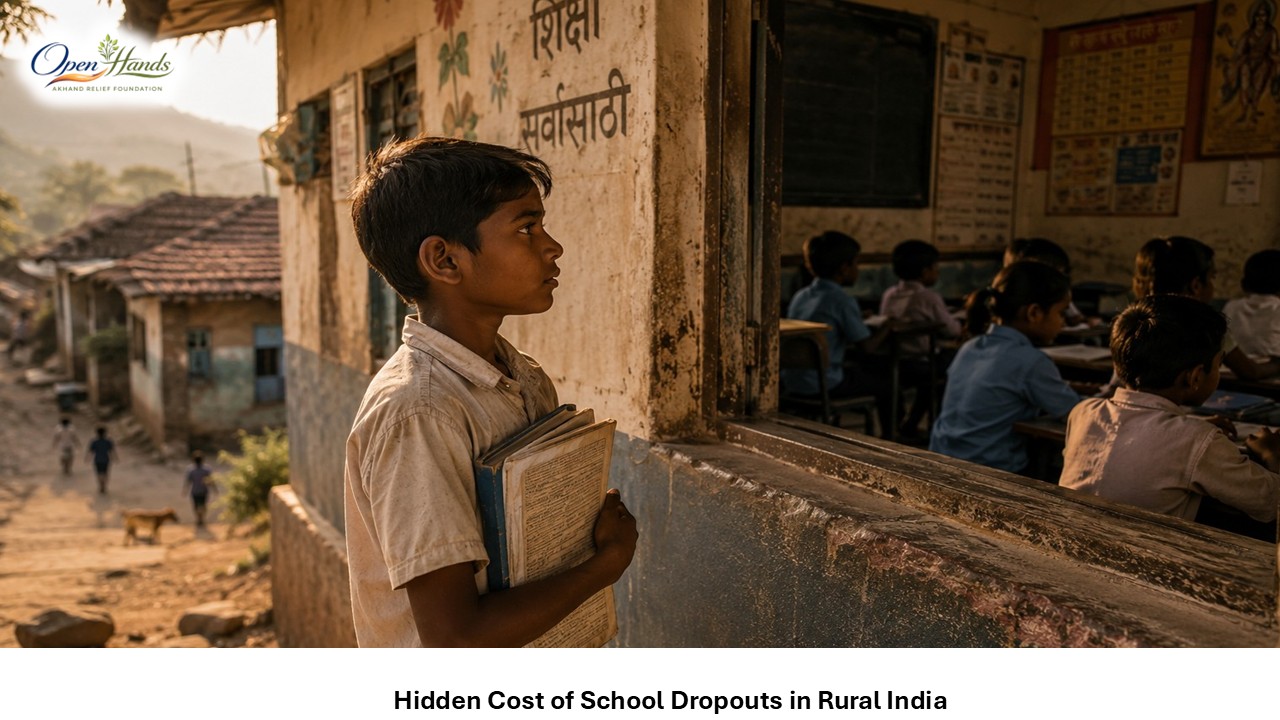
THE HIDDEN COST OF SCHOOL DROPOUTS IN RURAL INDIA
A child leaving school rarely happens in a single moment.
It usually begins with small disruptions that slowly become permanent barriers.
A missed fee payment. Seasonal migration. Lack of transport. Household responsibilities. Digital exclusion. Poor nutrition. Financial pressure. Over time, education becomes secondary to survival.
Across rural India, school dropout rates continue to reflect deeper social and economic vulnerabilities. While enrollment numbers may improve on paper, consistent learning access remains fragile for millions of children.
The real concern is not only that children leave school. It is what happens to communities when they do.
Education Is More Than Classroom Attendance
Education is often discussed as an individual opportunity. In reality, it is a long-term community infrastructure investment.
When children remain in school consistently:
- Household earning potential improves
- Child labor risks decline
- Early marriage rates reduce
- Health awareness increases
- Community participation strengthens
- Future generations gain better stability
When dropout rates rise, the opposite effects quietly spread through entire local economies.
The impact compounds over time.
Why Rural Students Drop Out
The causes are rarely isolated.
Economic Instability
Many rural families depend on seasonal or informal income. During financial stress, children are often expected to contribute through labor, caregiving, or household work.
Distance and Transportation
In many regions, secondary schools are located far from villages. Long travel distances increase absenteeism, especially for girls.
Digital Inequality
The shift toward digital learning exposed a major divide. Many students still lack reliable internet access, smartphones, or learning devices.
Nutritional Challenges
Children facing food insecurity struggle with concentration, attendance, and academic performance.
Lack of Academic Support
First-generation learners often do not have access to tutoring, mentorship, or home-based educational guidance.
These challenges do not operate separately. They reinforce one another.
The Economic Cost Is Massive
Every school dropout represents lost long-term productivity.
Communities with low education continuity often face:
- Higher unemployment
- Lower average wages
- Increased migration instability
- Reduced access to formal employment
- Greater dependence on informal labor sectors
Education is one of the few interventions proven to create intergenerational economic mobility. Losing students midway weakens the future workforce before it fully develops.
The cost is not only social. It is structural.
Girls Face a Different Set of Barriers
For many girls in rural India, staying in school depends on factors beyond academic performance.
Safety concerns, sanitation access, caregiving responsibilities, social expectations, and early marriage pressures all influence educational continuity.
When girls remain in school longer, measurable community outcomes improve:
- Maternal health indicators rise
- Household nutrition improves
- Child mortality rates decrease
- Financial participation increases
Supporting girls’ education is not a niche issue. It directly affects long-term rural development.
Why Scholarships Alone Are Not Enough
Financial support matters. But sustainable educational retention requires broader ecosystem support.
Effective community-based education models often include:
- Nutrition programs
- Transport support
- Digital access initiatives
- Parent awareness programs
- Mentorship systems
- Community learning centers
- Mental health and counseling support
Students stay in school when multiple barriers are reduced simultaneously.
The strongest interventions focus on continuity, not one-time assistance.
The Role of Local Organizations
Grassroots organizations are often better positioned to identify dropout risks early because they work directly within communities.
Local networks can recognize patterns that centralized systems may miss:
- Irregular attendance
- Financial distress
- Family migration cycles
- Health-related interruptions
- Gender-based challenges
This localized understanding allows interventions to happen before students permanently disengage from education.
Prevention is always more effective than recovery.
Building Systems That Keep Children Learning
The future of educational support in rural India will depend on long-term community systems rather than isolated campaigns.
Sustainable models prioritize:
- Consistent engagement
- Local partnerships
- Volunteer-driven mentorship
- School-community collaboration
- Technology-enabled learning access
- Transparent support mechanisms
Most importantly, they recognize that education support is not charity. It is foundational nation-building.
The Bigger Responsibility
Every child who leaves school carries untapped potential that communities may never fully recover.
Solving the dropout crisis requires more than increasing enrollment numbers. It requires building stable ecosystems where children can continue learning despite economic or social pressure.
The organizations creating meaningful impact today are those strengthening systems around students — ensuring education remains accessible, practical, and sustainable over time.
That long-term commitment to continuity is where real transformation begins, and it remains central to the community-focused initiatives supported through OpenHands Akhand Relief Foundation.